
The Declaration Act is not the problem.
It is part of the solution.
The Declaration Act Provides Certainty & Opportunity

The Declaration Act was co-developed by First Nations and the Province, and is an important economic driver for B.C.
Amending the Declaration Act will only create more uncertainty and more legal challenges.

The Declaration Act is something all British Columbians can be proud of, and we call on the Province to uphold it.
History of the Declaration Act
For over a decade, First Nations in B.C. advocated for a provincial legislative framework for the implementation of the 2007 United Nations Declaration on the Rights of Indigenous Peoples (UN Declaration). As a result, B.C. First Nations mandated the FNLC to co-develop, with the Province, the Declaration on the Rights of Indigenous Peoples Act (Declaration Act).
The Declaration Act aims to establish the UN Declaration as the framework for reconciliation for the Province, as called for by the Truth and Reconciliation Commission’s 2015 Calls to Action.
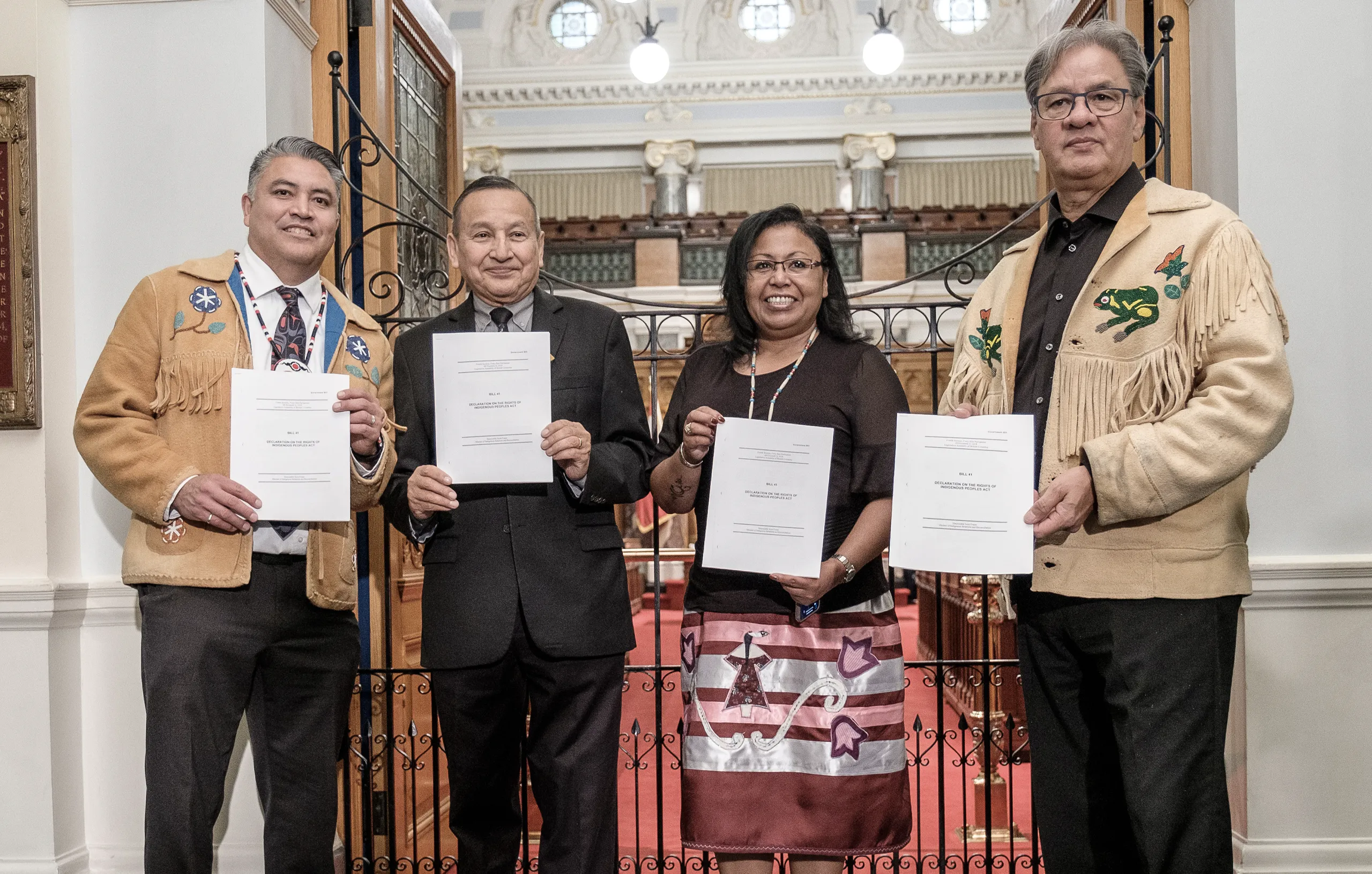
Passed unanimously in the B.C. Legislature on November 26, 2019, the Declaration Act came into force on November 29, 2019. This made B.C. the first jurisdiction in Canada to formally adopt the internationally recognized standards of the UN Declaration (Canada and the Northwest Territories have since passed their own related legislation).
Note on Terms
Both ‘Declaration Act’ and ‘DRIPA’ refer to the same piece of Provincial legislation, the Declaration on the Rights of Indigenous Peoples Act, which came into force in B.C. on November 29, 2019.
‘UN Declaration’ and ‘UNDRIP’ refer to the United Nations Declaration on the Rights of Indigenous Peoples, a resolution passed by the United Nations General Assembly on September 13, 2007.
‘UN Declaration Act’ and ‘UNDA’ refers to the Canadian federal legislation implementing UNDRIP, which received Royal Assent on June 21, 2021.
The Declaration Act requires the Province to bring provincial laws into alignment with the UN Declaration and to develop and implement an action plan to achieve the objectives of the UN Declaration in consultation and co-operation with Indigenous Peoples in B.C.
It creates a path forward to respecting the human rights of Indigenous Peoples, while introducing better transparency, predictability and accountability in Indigenous–provincial relationships.
However, starting in 2025 and in response to court decisions, the Province announced it plans to amend the Declaration Act to keep responsibility for consistency of provincial law with the UN Declaration under the oversight of the Legislature, rather than the courts.
The FNLC supports the Declaration Act as co-developed and passed in 2019, and calls on the Province to honour the Declaration Act and our mutual, vital work of reconciliation.
Declaration Act Successes
Tahltan Central Government – Eskay Creek Mine
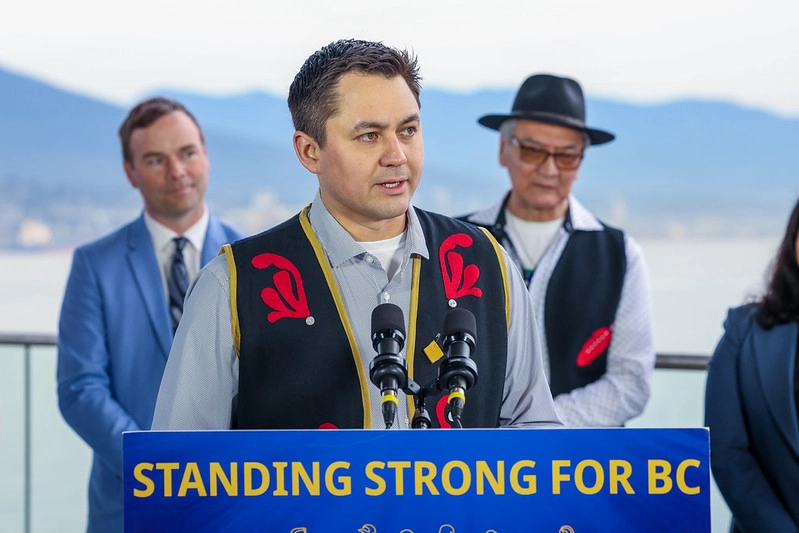
- The Eskay Creek Mine Project is the first to go through the regulatory process under a Section 7 agreement negotiated under the Declaration Act.
- The mine, owned by Skeena Gold and Silver, will create approximately 1,000 construction jobs and more than 770 operational jobs.
- Skeena Gold and Silver is advancing the mine in full collaboration with the Tahltan Central Government.
ʼNa̱mǥis First Nation – Forestry Agreement
- First-of-its-kind draft Section 7 joint decision-making agreement for the forestry sector under the Declaration Act.
- The agreement will support the joint establishment of forest landscape plans (FLPs) and joint approval of associated forest operations plans (FOPs) within Tree Farm Licence (TFL) 37, currently held by Western Forest Products.
- The agreement supports predictable harvesting and sustainable forestry operations on North Vancouver Island.
Declaration Act Agreements In Progress
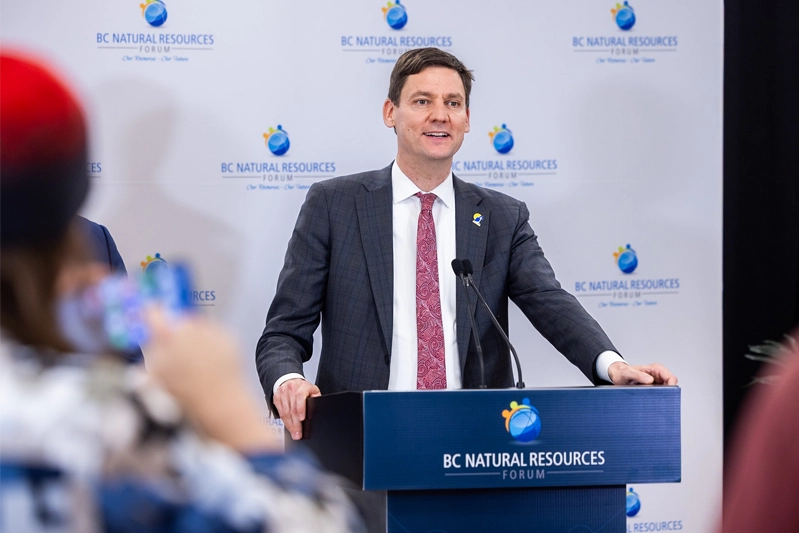
- Various other Sections 6 and 7 agreements under B.C.’s Declaration Act are currently in progress.
- These include an agreement with the Tŝilhqot’in National Government on mining in their territory.
- The Province is also working closely with the Tahltan Central Government on agreements related to the Galore Creek Mine Project, and the Red Chris Mine Project.
What the Government is Now Proposing
On the evening of January 29, 2026, the Province sent a notification letter to all 204 B.C. First Nations and representative First Nations organizations, announcing the Province’s intent to amend the Declaration Act and Interpretation Act for the spring legislative session.
The letter announced that the Province would begin an expedited consultation process on possible amendments to the Declaration Act, and described the Province’s intent as providing clarity for the continued work between the Province and Indigenous Peoples to reform provincial legislation in pursuit of consistency with the UN Declaration.
What the Government is Now Proposing
On the evening of January 29, 2026, the Province sent a notification letter to all 204 B.C. First Nations and representative First Nations organizations, announcing the Province’s intent to amend the Declaration Act and Interpretation Act for the spring legislative session.
The letter announced that the Province would begin an expedited consultation process on possible amendments to the Declaration Act, and described the Province’s intent as providing clarity for the continued work between the Province and Indigenous Peoples to reform provincial legislation in pursuit of consistency with the UN Declaration.
The FNLC’s Position
At a time of global instability and uncertainty, people are understandably looking for clarity, certainty, and leadership grounded in shared values.
- Difficult moments can bring out the best in us—or they can provoke fear-based reactions that risk undoing hard-won progress.
- Recent trends in British Columbia are cause for concern.
The FNLC takes direction from First Nations Leadership in B.C. and has a mandate to support implementation of the Declaration Act.
- B.C.’s 18 Major Projects’ future and revenue depend on working with First Nations, which is facilitated by the Declaration Act.
- Without the Declaration Act, our economic stability as a province is threatened.
- The Declaration Act provides a road map for industry, the Province, and municipal governments to work together with First Nations.
Attempting to amend the Declaration Act will land the Province in court again.
- The courts have upheld the need for deep consultation with First Nations, and the ambitious timeline that B.C. proposes for major projects in B.C. will be impossible without deep consultation.
- Taking away court accountability puts us back in time and increases the likelihood of litigation that First Nations are likely to win, based on court precedents.
- We can’t have the key Indigenous-specific piece of human rights legislation subject to cabinet will, when other human rights legislation is justiciable.
In the wake of the intersecting and complex realities of colonialism, government and society must work with First Nations to address how to move forward honourably, acknowledging that First Nations never ceded their title and rights.
- The Truth and Reconciliation Commission identified the UN Declaration as the framework for reconciliation, and implementation of the Declaration Act puts reconciliation into action.
- The Declaration Act provides a way forward to work together honourably.
We don’t change laws because they are inconvenient.
- We can’t just throw out legislation when it doesn’t suit political ambitions of the day; just because a law might be inconvenient, doesn’t mean it is wrong.
- The recent court decisions are helping to hold the government’s feet to the fire, but are not a signal that British Columbians should give up on reconciliation.
- We have the tools and a path, let’s focus on getting the work done.
Add Your Voice
How can you help?
Please add your voice to the call to support Indigenous human rights.


How We Got Here

September 26, 2023 – The B.C. Supreme Court ruled in the Gitxaala Nation and Ehattesaht First Nation case
- While the original decision ruled against B.C.’s online mineral claim-staking system (saying it excluded First Nations and violated the Crown’s duty to consult), the judge declined to grant the Nations’ requested declarations that the Province’s online mineral claim-staking system was inconsistent with the UN Declaration.
- The Nations announced that they would appeal.
August 7, 2025 – The B.C. Supreme Court’s Justice Young ruled in the Cowichan Decision
- The court found that the Cowichan have Aboriginal title to the Cowichan Title Lands under the 1982 Constitution Act; that the Crown grants of fee simple interest in the Cowichan Title Lands, and the Crown vesting of the soil and freehold interest in certain highway lands in the Cowichan Title Lands, unjustifiably infringe the Cowichan’s Aboriginal title; and that the Cowichan have an Aboriginal right to fish the south arm of the Fraser River for food under the 1982 Constitution Act.
- The Province announced that they would appeal.
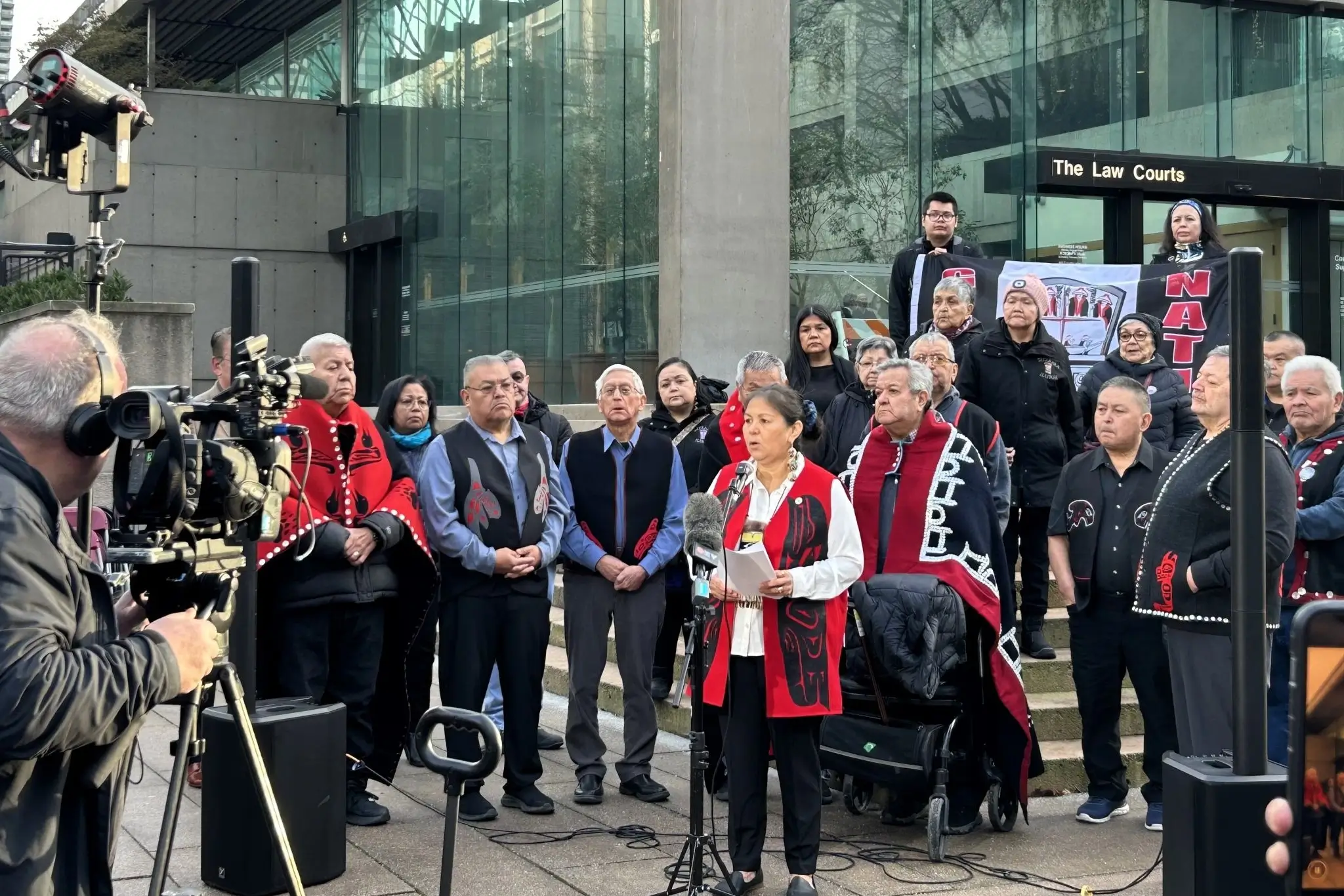
Gitxaala Nation representatives during Court of Appeal hearings in January 2025 (Photo: Alexis Stoymenoff, West Coast Environmental Law)
December 5, 2025 – The B.C. Supreme Court rules in the Gitxaala Nation and Ehattesaht First Nation Appeal Decision
- The judge partially agreed with the Nations, and declared that the Chief Gold Commissioner’s conduct in establishing an online system allowing for automatic registration of mineral claims without requiring prior consultation and cooperation of affected Indigenous peoples is inconsistent with article 32(2) of the UN Declaration. The judge ruled that the Declaration Act creates justiciable issues for courts and opens pathways for legal challenges where laws conflict with the UN Declaration on the Rights of Indigenous Peoples.
- The court rules that the province must take steps to resolve the inconsistencies between its mineral claims regime and UNDRIP rights and standards.
- The Province announced that they would appeal.
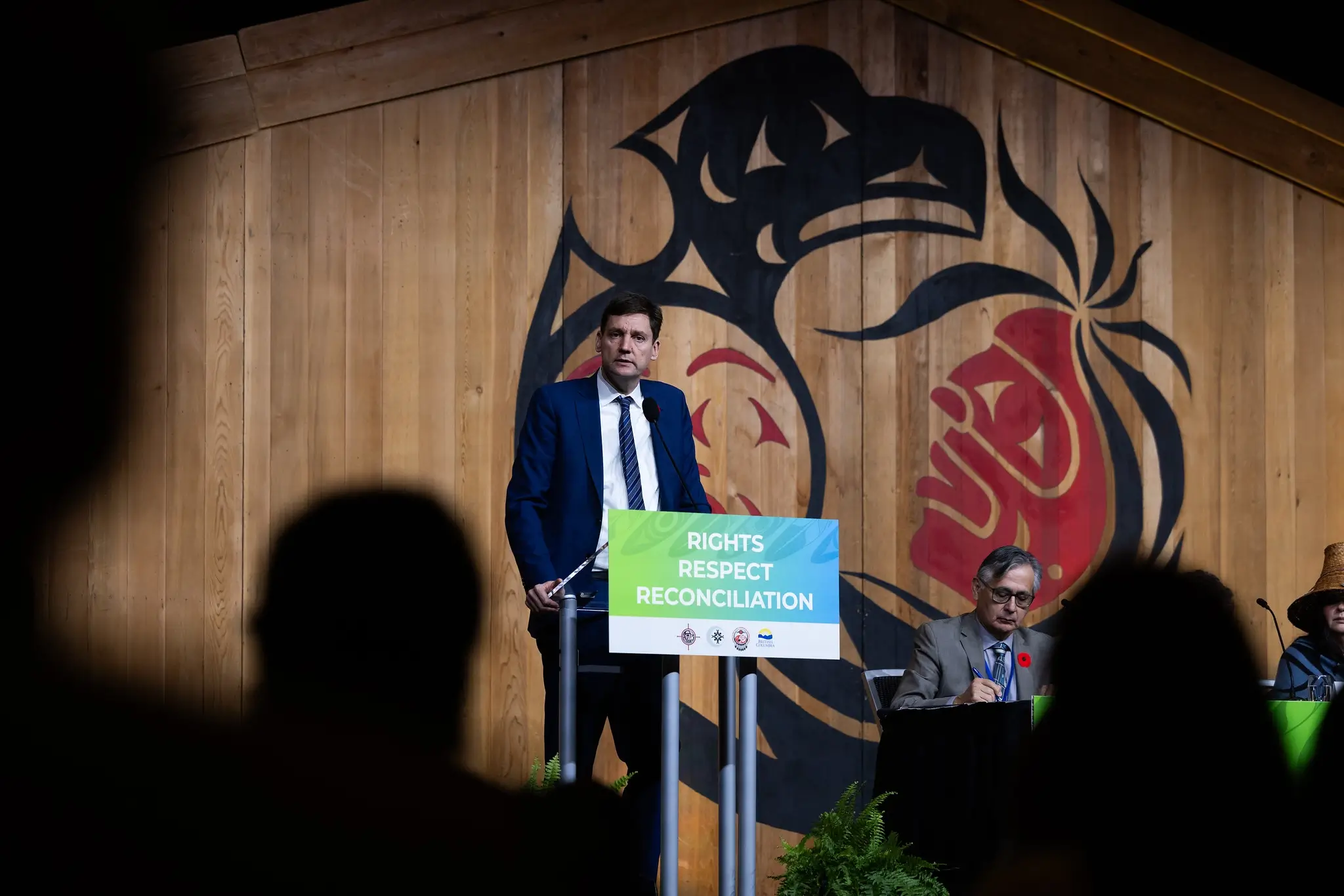
December 5, 2025 – Premier Eby says UNDRIP law could be amended after First Nations win appeal in mining case
- David Eby said: “Too much rides on it in terms of our province’s prosperity and certainty going forward. So, I think it just as likely or perhaps more likely that we would proceed with amendments to provide clarity around what was clearly intended when we introduced this legislation, and the court appears to have some confusion about that.”
- It is the B.C. Government’s view that the Court of Appeal interpreted the Declaration Act and Interpretation Act in a manner not intended by the Legislature, and that the Declaration Act and potentially the Interpretation Act must be amended to return the law to where it was prior to the decision.
Understand the Declaration Act
Show Your Support
First Nations & First Nation Organizations:
More than 100 First Nations Leaders Object to Amendments to the Declaration Act; Call for Province to Work Together with First Nations to Advance Reconciliation
A steadily growing list of more than 100 First Nations and First Nations organizations say amendments to the Declaration Act will undermine certainty and increase conflict and litigation if First Nations are forced to defend their rights.
Sign the Union of B.C. Indian Chiefs (UBCIC)’s joint statement.
Civil Society Organizations:
Joint Call: BC must recommit to meaningful implementation of the UN Declaration on the Rights of Indigenous Peoples and the Declaration on the Rights of Indigenous Peoples Act
Amending the Declaration Act or the Interpretation Act “would set back our collective reconciliation efforts by decades,” the joint statement warns.
Join the 80+ faith, labour, environmental, legal, academic, artistic and other community leaders in urging the Premier and all British Columbians to rise above anti-Indigenous and fear-based rhetoric to stand together for human rights and reconciliation.
Declaration Act Resources
- Joint Statement: B.C.’s Declaration Act Provides a Backstop of Certainty in a World of Chaos
- Law Society Statement on upholding the independence of the courts
- Statement from CBABC President Patricia Blair on Premier Eby’s plans to amend DRIPA
- B.C. Greens Reject Plans to Amend Declaration Act: Eby Must Defend Indigenous Rights
- Judges have last word on aboriginal law, not politicians, says former BC official, Geoff Plant
- To recognize aboriginal title is not to abolish property rights, but to uphold them
- Gitxaała v. British Columbia: What the Court of Appeal Decision Means for Indigenous Rights & BC’s Mining Laws
- November 2025 BCNDP Convention Resolution on DRIPA